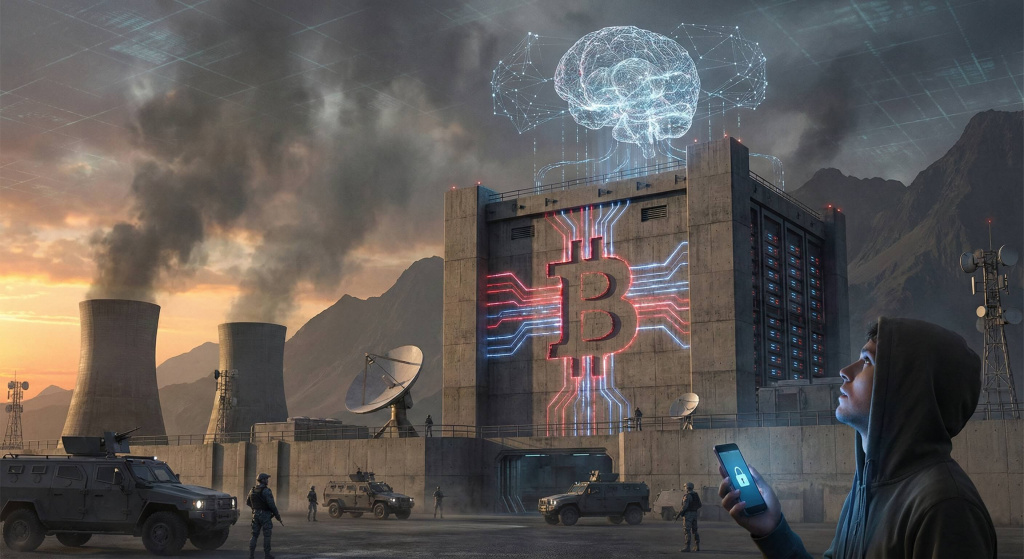
Bitcoin as Control Infrastructure

13.02.2026

286
How cryptocurrency financed AI’s compute substrate and rewrote the architecture of power
Contents
While the crowd watches candlesticks on charts in a trance, arguing about bitcoin’s price, the real plot unfolds in the shadows.
This is not a conversation about money, but about the very substance of power.
Cryptocurrency did not give artificial intelligence a “brain”; it forged the hardware skeleton for it and ran a global rehearsal of control.
Bitcoin, in its “digital gold” status, served as a proving ground ahead of a total reboot of the financial system.
The script is flawless: private money → bubble → mass habituation → state reserve → next step.
According to analysts, by early 2026 the U.S. government officially holds assets worth tens of billions of dollars. But that’s only the visible part: we don’t know the exact volumes in the wallets of the intelligence services. These are not trophies — they are the foundation of a new system of control.
1. Cybernetics. The cybernetic limit: why complexity always defeats law
The story of power in the 21st century is a story of lag. The Law of Requisite Variety, formulated by cybernetician W. Ross Ashby, sets a hard limit: a regulator can control a system only if its own complexity is not less than the complexity of the system it regulates. Put plainly: only complexity can control complexity.
Network society generates too many events: transactions, ties, supply chains, algorithmic markets, digital traces. Bureaucracy is a low-frequency machine; it reacts after the fact, when damage is already done. Law becomes too slow an instrument: it describes a world that manages to change three times while a new law is being adopted.
From this follows a cynical necessity: the state either increases the complexity of its control loop to match digital reality (AI, automation, transparent ledgers, risk profiles), or it simplifies reality itself to fit the old loop (quotas, checkpoints, scarcity, blocks). In both scenarios, freedom stops being the default and becomes a temporary permit.
Bitcoin was the first large-scale laboratory for this transition. It proved that a system’s stability can be secured not by trust and morality, but by rigid procedure and algorithm. Neural networks are the next level: they make this mechanism instantaneous. The system begins to govern not through prohibitions, but through the architecture of choice itself.
In this paradigm, artificial intelligence is a machine for suppressing unpredictability. The blockchain is an ideal ledger where behavior is permanently recorded as a graph of actions. Together they turn governance from “responding to an event” into predictive control: not punishing violations, but narrowing the space of possible actions in advance through limits and architecture. A permission regime is not a whim; it is the immune system of the Leviathan, welded into the infrastructure.
2. Economics. Market mutation: property as an obsolete file
This is how the very essence of economic relations shifts, forming a new language of reality. The market turns into an assembly line of continuous obsolescence, where the pace of progress is measured by the lifecycle of a chip, not the warranty card. The core asset becomes an “energy gate” — the ability to connect to compute power; power is now simply a derivative of access to the network.
Money in this system stops being a store of value and becomes a right to transact. You don’t so much own capital as receive a temporary permit to perform an action. Classical economics spent decades pretending money is a physical thing, but in reality it is only a social prosthesis of memory. The thesis “money is memory” sounds cynical — and hits the target.
When market participants are physically unable to store and verify the full history of mutual obligations, they need a portable surrogate. Blockchain made that memory cheap and totally public, and algorithms turned it into a lever of governance. This is how a “computational cens” emerges — a hard access threshold to technologies that permanently splits the world into users of beautiful interfaces and real owners of infrastructure.
3. Mining and AI. Industrial sacrifice: how mining became flesh for AI
Years of extracting cryptocurrencies on GPUs were not pointless electricity-burning, but a harsh infrastructure proving ground. Crypto turned the graphics card from a gamer’s toy into an industrial machine tool.
By writing off the crypto bubble as a banal mistake, we miss a fundamental pattern. Economist Carlota Perez describes an invariant scenario: the deployment phase of any breakthrough technology is almost always accompanied by speculative fever. Its real function is not to deceive the crowd, but to aggressively finance infrastructure that, at the start, is too expensive and too risky for rational capital. The railroads of the 19th century paid for the steel arteries of continents; the dot-com bubble financed the laying of fiber-optic backbones. The crypto mania did the same for compute capacity: ordinary people’s money, burning away on exchange charts, materialized into server racks of giant data centers, industrial cooling systems, and long-term energy contracts.
Now the second act begins. Once the digital “rails” are laid, real productive capital enters the stage. Artificial intelligence occupies already-paid capacity as an elite tenant, able to outbid any rate. A colossal infrastructure conversion occurs: the crypto industry, from scratch, grew an army of engineers who know how to squeeze maximum efficiency from cooling systems and energy logistics — and now all of that human and hardware arsenal is seamlessly absorbed by the new machine.
4. Energy. The thermodynamics of power: megawatts as a political weapon
The point where power becomes physically tangible is not a line of code, but a humming power transformer. Cryptocurrencies were the first to rehearse the model of global capital migrating toward sources of cheap energy, as a harbinger of a new “energy feudalism.”
Money is a technology of irreversibility. But in physics, irreversibility is never free. Landauer’s principle is uncompromising: any logically irreversible operation (in the limit, erasing a bit of information) inevitably requires dissipating heat. Order inside an information system is always paid for by rising entropy outside it. The Proof-of-Work algorithm made that price maximally public: for the past to become immutable, the network must pay with living energy.
Artificial intelligence activates the next phase of that same fundamental principle.
If mining bought the irreversibility of the past, AI buys a governable future.
Every prediction a neural network makes is a direct, energy-intensive payment for suppressing uncertainty. You can call it “Proof-of-Inference”: every generated answer has its own heavy thermodynamic footprint.
From this emerges a new political economy of power: megawatts and silicon chips are no longer raw material, but strategic weapons. They grant a monopoly right to compress data and exercise predictive control. In the 20th century, the power of states was measured by territory and factories; in the 21st — by algorithmic complexity, i.e., the ability to fit reality into the shortest machine description. Victory in this race goes to whoever can hold the most accurate model of the world and update it faster than competitors.
5. Instruments of control. Censorship through friction: power without a baton
The state is no longer fighting bitcoin — it is seamlessly integrating it into its institutions. The launch of crypto exchange-traded funds (ETFs) is not a triumph of decentralization, but an act of its institutional absorption. Through these gateways, the wild volatility of crypto assets dampens market shocks, stabilizing traditional fiat money, while institutional giants pump the freed capital into building a colossal hardware base for AI.
In parallel, “censorship through accounting” unfolds. Financial regulators deploy scoring algorithms to assess the cryptographic “cleanliness” of each coin. Total control is achieved by introducing algorithmic “friction” at the fiat off-ramps: formally, no one forbids you to hold “dirty” assets — but their legal conversion becomes prohibitively expensive.
Brute punishment becomes a relic when submission requires only changing your access settings: raising fees, cutting limits, programmatically slowing system response. This is an absolute dictatorship without a police baton — power through total transparency. The state can manage only what it can see clearly. Blockchain and continuous digital traces created “Transparency 2.0”: society now voluntarily, in real time, maintains a detailed cadaster of its own activity.
6. Society. Computational apartheid: the IP address as digital registration
The technological gap finally mutates into a class gap. We are moving from segregation by capital size to segregation by access to compute power. If power once controlled your transactions, now it controls your physical ability to think.
Prompt-proletariat: isolation in reputational ghettos
Before our eyes, a fundamentally new, rightless class is forming — the “prompt-proletariat”. It is a massive population allowed only a beautiful interface (a query line), yet tightly alienated from the factory that produces meanings. Intellectual potential is now measured not by the audacity of ideas, but by a quota of available gigaflops. The elite monopolizes compute tempo and hardware, leaving everyone else to be passive users of sterilized models that have passed harsh censorship.
But once a hard metric becomes the main target, it immediately breaks (Goodhart’s law). In response to total algorithmic scoring, a shadow industry of simulated trustworthiness will emerge: farms of “clean” IP addresses, generators of synthetic transaction histories, cryptographic “laundries” for washing digital reputation. Mining infrastructure and global botnets have already turned a significant part of the internet’s address space into a toxic wasteland.
From now on, the crystal cleanliness of your network footprint determines your baseline access to high-level AI. The IP address mutates into a rigid internal passport (digital registration): residents of new “reputational ghettos” will receive distorted answers with intentional latency or face shadow bans, irreversibly becoming cognitive outcasts..
7. Hardware. Silicon Darwinism: why ASICs became an evolutionary dead end
The term “conversion” sounds academic and gentle, but in practice it is a hardware purge. The heart of the bitcoin industry — specialized chips (ASICs) — cannot be repurposed for neural networks. They are perfect at solving one narrow mathematical task and useless at everything else. When AI capital arrives at a mining site, it buys only bare concrete walls and a power substation. The old compute equipment instantly becomes silicon scrap — classic sunk cost. The owners of crypto farms will fight desperately for their megawatts, but in the evolutionary war for energy, the winner is the one whose hardware can think.
For the state, a systemic energy shortage is strategically beneficial — it is an ideal instrument of social filtration. The lack of industrial transformers becomes a reinforced-concrete justification for strict priority queues. Energy shifts from a basic good into an elite privilege. And in an inseparable bundle with central bank digital currencies (CBDCs), money finally mutates into a programmable “subscription” or a capped quota of API calls.
8. Law. The migration of sovereignty: from courtrooms to server racks
The deepest, tectonic shift of the era is the physical relocation of sovereignty from bright courtrooms into humming server racks. Bitcoin proved in practice:
“code is law”.
The state silently absorbed this lesson and decided to monopolize the hardware base on which that code runs.
You can try to challenge a paper law in court; you cannot challenge hardware architecture — you can only execute it. If an absolute ban is welded into the logic of a microchip, the offense becomes physically impossible. In such a world, the legal norm is reduced to an ordinary parameter in an algorithm’s loss function, and real absolute power passes to whoever controls AI model weights and root encryption keys.
We are moving toward predictive governance via “digital twins.” Scenarios of new taxes or repressive sanctions will be simulated millions of times in state systems before being applied to living reality. Final, total control is implemented via hardware attestation (a trusted execution environment — TEE). Your personal device must cryptographically prove to a remote government server that it runs strictly “correct,” unmodified code. Fail a millisecond-scale hardware check — and you don’t get decryption keys to your own digital life. Thus the end-to-end architecture of the tech stack (chip → operating system → model) makes any unauthorized action technically impossible.
9. Scenarios. A tax on hype: how millions of investors paid for a digital trap
If we systematize what is happening, we can outline several non-obvious scenarios that explain the logic of events.
- First, the crypto mania brilliantly functioned as a global hype tax. Speculative азарт and animal fear of missing out (FOMO) forced millions of retail investors to finance, out of pocket, the construction of planetary energy infrastructure. Miners played the historic role of blind infrastructure laborers, pouring the hardware foundation onto which artificial intelligence now strolls in as the true and sole beneficiary.
- Second, the public blockchain served as an ideal honeypot (a digital trap) for data harvesting. The architects of the system deliberately allowed the shadow industry to grow, in order to collect a mathematically perfect graph of financial and social links. For years, neural networks trained to map anonymous digital traces to the crowd’s real physical behavior. And now, once behavioral patterns are de-anonymized, a systematic algorithmic process of asset extraction in favor of the Leviathan begins.
- Third, we are seeing a fundamental shift toward compute tokens (compute tokens). Under a growing energy deficit, a quota to run a heavy AI model (a machine-hour renting a GPU) becomes a far harder and more liquid currency than any fiat banknote. Future capital will be measured not by digits in a bank account, but solely by your priority position in the queue for server capacity.
- Fourth, bitcoin became a large-scale stress test for fiat money — a global test range for macroeconomics under total transparency. For states, it was a perfectly safe way to identify systemic vulnerabilities before launching their own digital currencies, cynically shifting financial risk onto private investors. At the same time, a digital “controlled burn” was underway: a deliberately maintained gray zone helped lure into the open the most passionate, entrepreneurial, and systemically noncompliant actors, carefully collecting comprehensive datasets on them for future AI investigators.
Finally, a total energy-compute cens is forming. Classical economics degrades into a form of biopolitical control, where the basic right to physical movement or consumption is welded to one’s hardware-computed trustworthiness (the size of an allowed carbon and compute footprint). And colossal state bitcoin reserves become a bottomless liquidity pool for government trading algorithms, enabling authorities to zero out unwanted private capital in milliseconds via high-frequency market interventions.
EPILOGUE. THE CONSTITUTION OF INEVITABILITY
Bitcoin’s price was just informational noise. The real plot was different: for the first time, on a mass scale, the world was shown that in digital reality irreversibility has a physical price. Not moral, not legal, not political — but thermodynamic.
Landauer’s principle rigidly fixes the lower bound: any logically irreversible transformation of information (in the limit — erasing a bit) requires energy dissipation of at least k_B·T·ln2 and inevitably obeys the second law of thermodynamics. This is not someone’s opinion and not a social contract. It is a foundational boundary of the physical world. And Proof-of-Work made that boundary social: the past of a digital ledger becomes unshakable only insofar as you are willing to pay for its irreversibility in joules. “Truth” turned from a philosophical claim into a direct payment: if you want an unrewritable fact — pay with dissipated heat.
Any attempt to find a loophole through “more efficient computation” crashes into the same physics. Yes, reversible computing is theoretically possible — but a real system lives at finite temperature: in background hardware noise, with errors, desynchronization, caching, logging, algorithmic garbage collection, and state overwrites. System reliability is always paid for by energy dissipation, because it is precisely dissipation that guarantees the distinguishability and stability of these zeros and ones. You can approach the thermodynamic limit as closely as you want — but you cannot avoid paying the bill. In disputes about power and infrastructure, physics closes the discussion first: the second law of thermodynamics is not put to a vote, and a power transformer does not read a constitution.
AI is the second act of the same play, only it moves the payment from the past to the future. If mining bought the irreversibility of protocol history, then machine inference (a neural network’s output) buys a governable trajectory: the right to suppress uncertainty at lightning speed, narrow the space of options, and present the most probable as the rational norm. In informational terms, it is a reduction of uncertainty (Shannon entropy); in physical terms, an inevitable rise of thermodynamic entropy around red-hot compute clusters. That is why model speed is no longer merely a question of technical “performance.” It is a political lever: whoever updates the machine description of the world faster is the first to turn an incoming signal into an order — and begins dictating to everyone else what now counts as reasonable.
At this point, the very nature of money changes decisively. When the cryptographic ledger became cheap and universal, money stopped being a thing and became memory. But once that memory became computable, money stopped being even that. It turned into a system of permissions: a license to act, a quota of API calls, a basic right to convert energy into a ready decision. Economics quietly migrated from the paradigm of ownership to the paradigm of permissions. What matters is no longer “how much you have,” but “what you are algorithmically allowed to do” — buy, transfer, train a model, send a query, generate content, prove a fact, challenge a decision. And this is not a new ideology, but harsh engineering logic: in a world of hard scarcity of energy and compute, any value inevitably crystallizes as access to a scarce channel.
Next comes the most frightening shift, one that deprives us of the familiar humanitarian arguments.
Power migrates from the text of law into the software architecture of code.
You can argue about law, interpret it, bypass it in court, or sabotage it. Architecture cannot be “appealed” — it can only be executed.
That is why an evolved control system no longer needs crude bans and punitive measures. It needs only systemic “friction” — invisible parameters that do not look like repression, but work the same way: algorithmic delay instead of a sentence, a reduced transaction limit instead of a tribunal, a prohibitive tariff instead of morality, a low queue priority instead of political debate, a programmatic authorization denial instead of a counterargument. The most perfect form of coercion is the one in which disobedience turns not into a criminal offense, but into a technically impossible instruction: “the process won’t start,” “the device failed attestation,” “no valid key.”
And here it is crucial to name things as they are: what we are seeing is not a conspiracy and not the “evil will” of elites, but a ruthless cybernetic necessity. Ashby’s law of requisite variety coldly formulates the limit: a control loop retains control only if its own complexity does not lag behind the complexity of the system it governs. The digital environment is super-complex, nonlinear, and runs at extremely high frequencies; human bureaucracy, by nature, is low-frequency. Therefore, the Leviathan either becomes algorithmic itself (increasing the complexity of its tentacles to match reality), or it forcibly simplifies reality, driving it into narrow, manageable corridors — via quotas, digital checkpoints, compulsory priorities, and network filters. And because any metric, once it becomes the target, immediately stops working (Goodhart’s law), control predictably grows down into the fundamental hardware layer: from external social scoring to deep verification of trusted execution environments (TEE), from after-the-fact evaluation of behavior — to hard verification of the physical possibility of an act.
This is why the “Computational Cens” is no longer a catchy metaphor, but a precise term for a new political economy. Its base accounting unit is not the dollar and not a legal right, but your personal entropy budget: how much energy and processor time you are permitted to burn to impose order on information. That is: to fix a fact, get an answer from AI, compute a plan, simulate consequences, or simply produce new meaning. This budget is not distributed from parliamentary podiums, but at the level of network infrastructure. Its true “constitution” is welded into the hardware layers that cannot be persuaded, softened, or reasoned with:
If you do not physically control at least one layer of this chain, you are not an owner and not a political subject. You are merely a rightless user of someone else’s interface. And any interface, by definition, is configured from the outside: platform owners can quietly cut the depth of your answer, speed, accuracy, context, your right to convert assets, or the basic right to compute. One silent background update of user policies — and your personal reality becomes slower, narrower, and poorer. And it happens not because you were officially “banned” or “canceled,” but because your horizon of the computable world was remotely constricted.
Bitcoin was only a planetary proving ground: it trained millions of people to accept that a social contract can be welded into a cryptographic protocol. Artificial intelligence completes this inversion: now a machine protocol governs not only transactions of value, but the production of meaning — the very mechanism by which we orient ourselves in the world. That is why the main question of the coming era is no longer “how much money do you have?” or even “do you have a neural-net subscription?” The question is harsher and more frightening: what is your personal hardware limit for suppressing uncertainty, who sets it, and can it be revoked with the flip of a switch — along with your subjecthood?
A dry conclusion with no comfort, in the cold language of systems theory: freedom is now the throughput of the channel through which you convert energy into information, and information into physical action. Power is the monopoly right to grant, calibrate, and revoke that throughput.
The formula of absolute power in the 21st century closes into a rigid, inseparable triad:
- Energy — the thermodynamic substrate of power.
- Model — the algorithmic converter of that energy into concrete decisions.
- Key — the cryptographic mechanism that distributes permissions to this chain.
The one in whose hands all three elements converge does not merely define markets or the rules of the game. They set the boundaries of computable reality itself — and therefore the limits of what people will, in principle, be allowed to consider possible, rational, and “theirs.” This is the absolute crown of control: the transition from punishing misdeeds to hardware-level design of the very human capacity to act.